Eating Habits
Why Food Cravings Aren't a Willpower Problem — The Neuroscience of Addiction
Food cravings aren't about willpower — they're how your brain's neural circuits are wired. Here's the neuroscience of cravings explained by Kessler and Hari, the truth about GLP-1 drugs, and 3 paths to recovery.
- #food cravings
- #food addiction
- #dopamine diet
- #mindful eating
- #intuitive eating
- #binge urge
- #GLP-1
- #Wegovy
- #Mounjaro
- #yo-yo
- #reward circuit
- #SURMOUNT-4
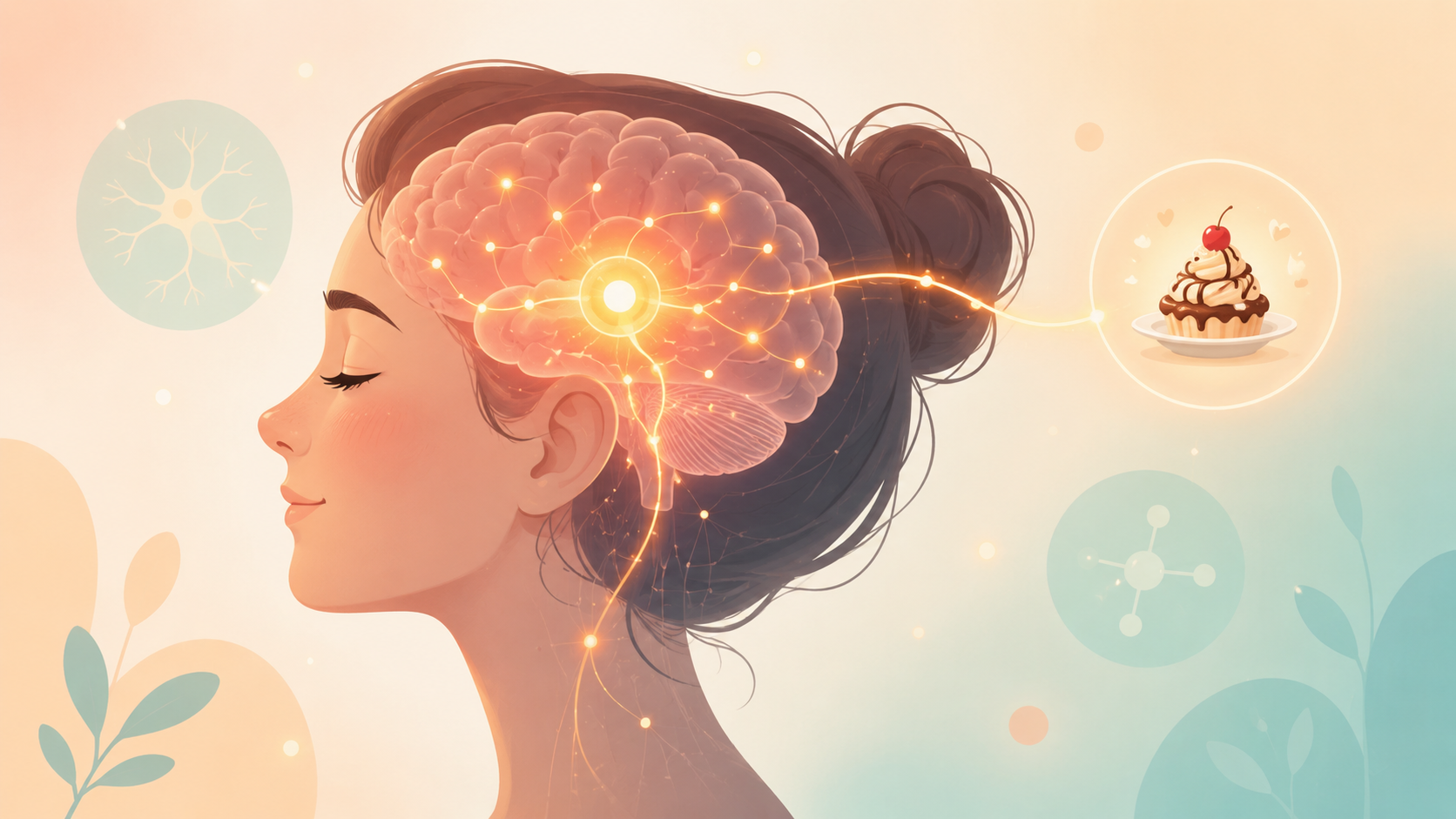
Why Food Cravings Aren't a Willpower Problem — The Neuroscience of Addiction
A few hours after dinner, some people hear an alarm clock go off inside their head.
Sitting at the computer, a sudden wave of anxiety and restlessness sweeps in.
'Should I go downstairs and grab something to eat? Why can't I just control myself?'
The feeling grows and grows, and when you try to suppress the urge, it can even turn into a physical ache in your head.
This isn't the story of someone with a binge-eating history.
It's the personal experience that former FDA commissioner David Kessler describes firsthand in his book "The End of Overeating."
Even the head of the Food and Drug Administration couldn't stop food cravings through willpower alone.
Why is that?
The first thing we want to tell you in today's article is this.
Food cravings are not a willpower problem. They are the result of how your brain's neural circuits are designed.
Among the people we at KkokKkok have met, those who have struggled for years with bingeing and diet obsession are the slowest to accept this fact — because everyone has always told them to "build more willpower."
In this article, we'll walk through the neuroscientific mechanism behind food cravings, the 3 paths out of craving, and how GLP-1 drugs (Wegovy, Mounjaro) affect cravings.
The decision is yours; we're simply here to give you information.
Cravings Aren't a Willpower Problem — Craving vs. Impulse
First, we need to clear up the terms.
An impulse can be strong, but it's temporary. It passes.
A craving is different. If it isn't satisfied, unpleasant mental and physical symptoms follow.
Put simply — a craving is directly linked to pain.
A state where food won't leave your mind. Where you can't focus on anything else. Where no matter how you try to distract yourself, only that one food can quiet the noise.
That's a craving. It's exactly the same as what people in general addiction studies describe.
One person we worked with said this:
"Even when I go to a cafe with friends, they focus on the conversation, but I'm only thinking about the dessert in the display case."
How cravings get triggered — the power of cues
Kessler organizes the triggers into four kinds of cues.
Sight — a photo of cake, the bakery display case
Smell — the scent of baking bread, the aroma of coffee
Place — the cafe you often eat at, your bed
Time — that hour when you eat a late-night snack every day
Just these cues nudge dopamine up a little, and a sense of deprivation follows right after. That deprivation creates the urge.
"The smell of cake," "that hour," "that place" stop being mere information and become switches that shake your brain.
One person we worked with put it this way:
"The moment I walked past that cafe on my way home from work, I could already see the dessert in my head.
Before I'd even decided to buy it, my hand was already moving."
That's the automatic response a cue creates.
Then the food industry piles on. More stimulating, more calorie-dense foods are easily accessible everywhere.
There are so many cues that avoiding them is essentially impossible.
3 Paths Out of Craving
Kessler proposes three approaches.
① Reward substitution — planting a new behavior
This means replacing the existing addictive behavior with a different reward.
If cookies or bread desserts held the place of pleasure, you have to put a different pleasure in that spot.
A cup of your favorite tea, a 10-minute walk, a short phone call, a chapter of a book.
At first it's weak. It doesn't match the intensity of dessert.
But as you repeat it, your brain learns the new pattern.
② Avoidance motivation — changing the environment itself
This means putting distance between yourself and the trigger.
Cleaning out the fridge — not keeping the foods you tend to binge on
Taking a route home that doesn't pass the bakery
Honest awareness of the industry that engineered processed food — letting go of the assumption that "I deserve to eat this"
Just as cigarettes came to be seen across society as "a substance to avoid," building distance from your own binge triggers is one direction of recovery.
③ Calm state — making balance itself the reward
This is the deepest path. For more, see:
👉 Internal link: How to Build a Body That Doesn't Gain Weight — 6 Routines for No Rebound (Part 3)
Before the Craving Comes — The Power of Prevention
The most important thing — is preventing cravings from arising in the first place.
If you have a habit of eating late at night, schedule sleep or a more absorbing activity for that time.
And the key is to check the emotion right before the urge to eat strikes.
"Why do I want to eat?
Because I'm bored? Stressed? Guilty, helpless?"
When you notice this — you can shift your physical state or change your environment and step out of the eating behavior.
The power of embodied activity
Johann Hari, author of "Magic Pill," says physical activity is especially effective.
He calls it embodied activity — activity that makes you feel that you are present inside your own body.
Dancing
Yoga
CrossFit
Soccer
Even swinging your arms counts
These activities create a sense of pride that "my body can do this too."
A positive body image forms, and you naturally come to value your own body more.
Then your food choices change too. You start choosing foods that help you rather than harm you.
Are GLP-1 Drugs the Answer? — The Truth About Cravings and Rebound
These days many people use GLP-1 drugs like Wegovy and Mounjaro.
This drug is, in fact — the most powerful way to break a craving.
Both Kessler, author of "The End of Overeating," and Johann Hari, author of "Magic Pill," used this drug.
Their weight dropped in no time.
Two systems GLP-1 acts on
- Overwhelming the reward system
GLP-1 drugs work because they're potent enough to overwhelm the reward system, triggering fullness without eating much.
Kessler says that from the very evening he injected it, he couldn't eat a proper bite.
Not only his appetite but the craving itself changed, so he no longer wanted salt, fat, or sugar.
- Activating the aversion system
GLP-1 also stimulates the hindbrain, where the nausea and vomiting centers are.
GLP-1's signature side effects — gastrointestinal upset and nausea — come from here.
The drug activates the aversion system that pushes you away from unpleasant or dangerous stimuli.
But when you stop, it comes back
This is where the real problem begins.
There's evidence that one year after stopping semaglutide (Wegovy), two-thirds of the weight returns.
In one clinical study, 70.6% was regained within 48 weeks of stopping.
The SURMOUNT-4 study on Mounjaro (tirzepatide) is even more striking.
82% regained more than 25% of the weight they'd lost within a year
24% (1 in 4) regained more than 75%
Not just weight, but blood pressure, HbA1c, lipids, and waist circumference all regressed too
Dr. Azagury, chief of bariatric surgery at Stanford, says the same thing.
"When you stop the drug, most people gain it back."
Why?
Kessler gives two reasons: the influence of the addiction circuit, and metabolic change.
When you stop the drug, the fullness that was its hallmark disappears, and reward reactivity rises again.
So why use the drug at all?
Kessler's answer is striking.
"The reason to use GLP-1 is to change our relationship with food in the very moment we take it."
The drug is a powerful tool for breaking a craving.
But while that window of opportunity is open — unless you change your eating habits and behavior alongside it — the moment you stop the drug, everything comes back.
In fact, a recent guideline came out for people stopping GLP-1.
Patients who followed a low-carb diet and received intensive behavioral coaching maintained their weight loss.
👉 Internal link: "Why Does the Yo-Yo Happen? — The Hormonal Mechanism" (Part 4)
👉 Internal link: Can You Afford Mounjaro for Life? The Price Question (Part 2)
👉 Internal link: Is 2.5mg of Mounjaro Enough? — The Questions Low-Dose Users Ask Most
In Summary
**Food cravings are not a willpower problem — they're how the brain's circuits operate.
A drug can suppress those circuits temporarily, but when you stop, they come back.
In the end, you have to change your behavior while the drug is doing the suppressing.**
Among the people we at KkokKkok have walked alongside, those who broke out of the endless loop of dieting and rebound always had one thing in common.
It wasn't the ones who used the drug well — it was the ones who rewrote their craving circuits during the time the drug was working.
─────────────────────────────────────
📩 Turn the moment a craving hits into a healthy habit
At KkokKkok, we've built routines that help you notice the very moment a food craving strikes and tip the scale back toward calm with small actions.
If you're using GLP-1 and afraid of the rebound, or you want to break out of the diet-and-binge cycle — start with a small tool.
[1차 CTA: 7일 무료 챌린지 시작하기 →]
[2차 CTA: 꼭꼭 코치 무료 진단 신청 →]
─────────────────────────────────────
❓ Frequently Asked Questions (FAQ)
Q1. How is a food craving different from an impulse?
An impulse is strong but temporary — it passes with time. A craving is different. If it isn't satisfied, unpleasant mental and physical symptoms (anxiety, restlessness, emptiness) follow. You can ignore an impulse, but ignore a craving and it soon returns as pain.
Q2. How can I notice the "cues" Kessler described in daily life?
Check the four: sight, smell, place, and time. Just record for a few days what the environment was right before your usual binge or late-night eating — the time, place, and what you saw or smelled — and the pattern becomes visible.
Q3. Do mindful eating and intuitive eating really work?
They're scientifically validated approaches. Many studies show they produce better long-term results for weight maintenance and mental health than obsessive dieting. That said, you need at least 3–6 months of consistent practice to see the effects.
Q4. Can cravings remain even while using GLP-1 drugs?
Yes. GLP-1 is powerful enough to overwhelm the reward system, but it doesn't work the same for everyone. Emotional and stress-driven appetite in particular often slips past the drug. That's why it matters to build behavioral routines while the drug is suppressing cravings.
Q5. What's the fastest way to stop a craving when it hits?
Start by noticing one line: "Why do I want to eat right now?" Emotions like boredom, stress, and loneliness are often the trigger. Then change your physical state. A 5-minute walk, stretching, moving to a different place — small movements break the cue circuit.
Q6. What does it mean that a calm state becomes a reward?
At first it feels weak compared to the intense pleasure of dessert. But if you repeatedly experience the calm of your parasympathetic system activating after a meal through mindful eating, your brain learns that state itself as a reward. Then your dependence on dessert naturally decreases.
Q7. I binge often — when do I need professional counseling?
If uncontrollable bingeing continues more than twice a week, or if purging behaviors (vomiting, excessive exercise) accompany it, that's the point to seek professional help. We recommend objectively checking your state through a free KkokKkok coach assessment.
※ This article is not medical advice and is written for general informational purposes.
If bingeing significantly disrupts your daily life or is accompanied by physical symptoms, we recommend consulting psychiatry or endocrinology.