Eating Habits
The One Thing You Used to Lose Track of Time Doing as a Kid — The Single Activity That Can Replace Bingeing
Replacement behaviors aren't built by willpower. They're about rediscovering the immersion circuit you already had. We've organized it with real graduate stories.
- #식습관
- #폭식
- #GLP-1
- #위고비
- #마운자로
- #위고비 중단
- #위고비 요요
- #다이어트
The One Thing You Used to Lose Track of Time Doing as a Kid — The Single Activity That Can Replace Bingeing
In our last article (Part 1), we pointed out one thing.
The real reason weekend bingeing never stops isn't willpower — it's that your brain automatically predicts "eating" during that time slot.
So the key isn't to eliminate eating — it's to fill that empty space with something else.
Today we'll dig deep into that answer.
It's the most honest answer to the question, "So what should I do instead of late-night snacking?"
We'll walk through how the people we've met escaped bingeing, and the personal replacement behaviors our graduates discovered.
👉 Internal link: Why Food Cravings Aren't a Willpower Problem — The Nature of Addiction Through Neuroscience
The decision is yours; we're just here to share information.
Part 1's Answer — Filling the Space Is the Key
Let's revisit Part 1's conclusion one more time.
The moment you turn on Netflix at 8 PM, your brain is already predicting that "the end result is eating."
You can suppress that automatic loop with willpower for a few days, but eventually it collapses.
The key is to train a different behavior into that space.
But here's where many people hit the first wall.
"I don't know what that other behavior could be."
"I've tried exercise, reading, walking — all of it. I did them for a few days and then quit."
Why does this happen?
Because just inserting any random behavior doesn't change the automatic loop.
The new behavior that goes into that space has to be attractive enough for you.
Attractive enough that your hand reaches for it instead of food, that you lose track of time.
If it isn't, your brain eventually returns to the familiar automatic loop.
So the real question is this.
"What can I get so immersed in that I lose track of time?"
Finding the answer to this question is the most honest path out of bingeing.
Things People Got Immersed in Instead of Bingeing — Two Experiences
Let me share the stories of two people we met who escaped bingeing.
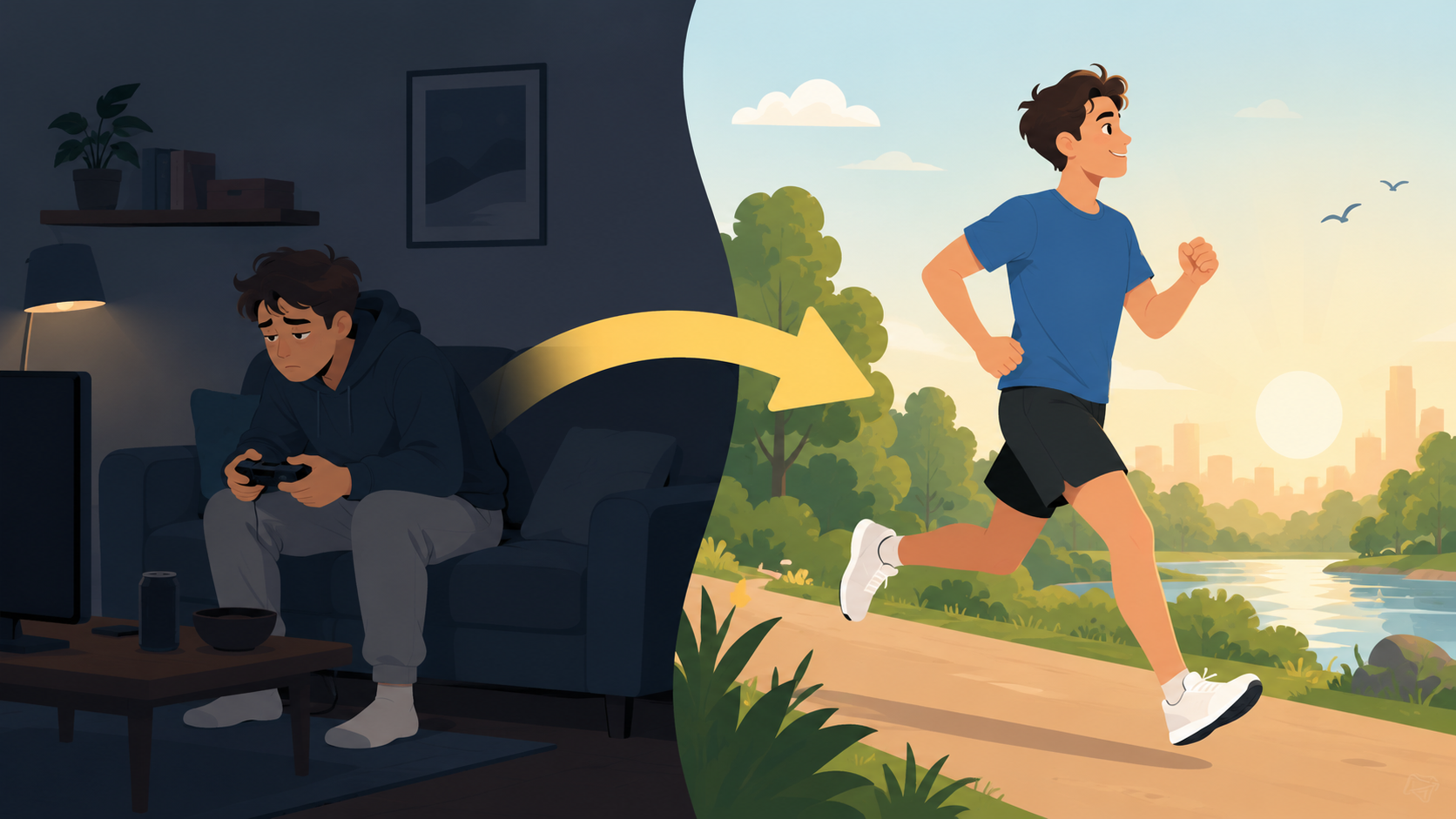
The First Person — From Gaming Addiction to Exercise Addiction
This person had loved games since childhood.
Whenever there was academic stress or family conflict, they played games.
On weekends they'd game all night and order a whole pizza in the morning — it became the curtain call of daily life.
"It was really a part of my everyday life. I couldn't stop."
But at a certain turning point, this person became hooked on exercise instead of games.
The feeling of going crazy if they didn't game for even a day turned into going crazy if they didn't work out for even a day.
How did they change it?
They didn't use willpower.
"I didn't use willpower to quit gaming — I found a new place of immersion in exercise."
Looking back at their childhood, they remembered playing outside with friends from morning to evening every weekend in elementary school.
That time when they felt so sad when their parents told them to come home in the evening.
They were someone who naturally loved moving their body.
Realizing that, they started with light walks, then the gym, and now they've been doing CrossFit for over two years.
"When I exercise, time flies by just like it did when I gamed.
The emptiness I used to feel after gaming turned into a sense of accomplishment and positive thinking after working out."
The Second Person — From Drinking and Bingeing to Immersion in Work and Content
Another person had a period of severely repeated drinking and bingeing.
On weekends they'd eat from morning until late-night snacks and regret it the next day.
But now they don't budge from their computer. They're deeply absorbed in their work.
This person also looked back on their childhood.
When their parents turned off the lights and told them to sleep, they'd pull the blanket over their head and secretly draw things like comics.
Whatever character they drew, that sense of immersion in the moment, that feeling of losing track of time.
They now rediscover that feeling in creating content, drawing Instagram cartoons, and building app services.
"I work until 1 or 2 AM thinking 'I should sleep now,' and when I snap out of it, it's 3 AM.
I lose track of time. And I really love that."
Do you see what these two people have in common?
Neither of them quit bingeing or addiction through willpower. They rediscovered the circuit — the thing they used to get immersed in as children, losing track of time.
Graduate Cases — DIY and Drawing/Transcription
Let me share two more stories of people who joined our coaching program.
One Person — DIY Plastic Models
Every Sunday night, this person's final ritual of the week was chicken, beer, and YouTube.
After starting coaching, they built the habit of "eating mindfully," and for the first time experienced finishing a planned meal without bingeing.
"I can't believe I'm able to finish a meal like this. I was so amazed."
But a problem came up. Since they weren't bingeing or watching YouTube, that time felt empty.
"What should I do during that time? So thoughts of food started coming back."
We asked them what they used to enjoy as a child.
They said they really loved assembling and building things.
These days you can easily buy DIY kits online.
At first they didn't do it much. They were tired from work.
But little by little, after coming home from work, they started making time to use their hands while tidying up — and as they watched their binge frequency gradually drop, they became hooked on building plastic models.
"Now when I start at 8 PM, I lose track of time even when it hits midnight.
I don't think about late-night snacks. My hands are too busy to even have the chance."
Another Person — Drawing, Transcription, Gratitude Journaling
This person ate snacks every evening while watching Netflix — three bags of chips was the baseline.
When we asked what they liked as a child, they said they loved drawing and writing things in a sketchbook.
Now they draw every evening, transcribe passages from books they love, and there are people who also keep gratitude journals.
Let me share a few other small starting points.
Doing puzzles — hands and vision focus at the same time
Coloring books — adult coloring books, surprisingly powerful
A 10-minute walk — getting away from the space with the cue
5 minutes of stretching — releasing the body's tension
These small behaviors are also very helpful for breaking the automatic loop of "eating while watching."
Conclusion — It's Discovered, Not Created
If we compress today's content into one line, it's this.
Replacement behaviors aren't built by willpower — they're about rediscovering the immersion circuit you already had.
Games → exercise.
Late-night snacks → work and content.
Chicken and beer → DIY plastic models.
Netflix and snacks → drawing, transcription, gratitude journaling.
The answer these people found was the adult version of the very thing they used to do as children, losing track of time.
"What did you do as a kid that made time disappear?"
Finding the answer to this question is the most honest start to escaping bingeing.
Among the people we've worked with, those who escaped the endless loop of dieting and bingeing always had this in common.
They weren't people who grew their willpower — they were people who discovered something they could truly get immersed in during that time.
📩 Let's Find Your Own Answer Together
At Kkokkkok, we help you rediscover the thing you used to do as a child while losing track of time, and we design it together so that behavior can take the place of bingeing.
Start the 7-Day Free Challenge →
Apply for a Free Kkokkkok Coach Diagnosis →
👉 Internal link: Why Food Cravings Aren't a Willpower Problem — The Nature of Addiction Through Neuroscience
❓ Frequently Asked Questions (FAQ)
Q1. What if I can't remember what I liked as a child?
In that case, start with small entry points like a warm bath, puzzles, coloring books, or a 10-minute walk. Behaviors that use your hands or calm your senses immediately reduce binge urges. As you do them, you'll begin to observe what you're naturally drawn to.
Q2. I start a new hobby but quit within a few days.
That's because the behavior isn't attractive enough for you. A behavior you started because "people say it's good" doesn't enter the automatic loop. It's more effective to find clues in your childhood memories about what you get so immersed in that you lose track of time.
Q3. Why don't general recommendations like exercise and reading work?
Because they're generic. Exercise isn't right for everyone, and not everyone gets immersed in reading. Finding the immersion circuit already inside you is much faster than trying to build a new one from scratch.
Q4. Does a warm bath really reduce appetite?
Yes. Soaking your body in warm water activates the parasympathetic nervous system, and your brain starts to learn that "it's okay not to eat during this time." About 30 minutes is ideal, and if you do it at the same time every day, the effect of blocking the automatic loop becomes even stronger.
Q5. How long does it take for a replacement behavior to settle in?
Generally, research says it takes about 21 to 66 days for a new behavior to become automatic, but if it's a behavior that's genuinely attractive to you, it settles in much faster. Among the people we've seen, some broke their late-night snacking loop in just two weeks.
Q6. I live with family, so it's hard to make immersion time for myself.
This is a really common difficulty. What we recommend most is creating your own immersion corner, even in a small space. A corner of the dining table is fine, or a desk. Once that space is learned as a cue that "this is where I do ◯◯," the automatic loop starts to form.
Q7. How do I apply for the Kkokkkok Fit program?
Kkokkkok Fit is a 12-week program where a coach manages your meals daily, with 1:1 online PT and weekly lectures and assignments. Over 60 people have already experienced an 80%+ reduction in binge frequency. You can apply through the Kkokkkok app or our official channels.
※ This article is not medical advice and was written for general informational purposes.
If bingeing significantly disrupts your daily life or is accompanied by physical symptoms, we recommend consulting a psychiatrist.